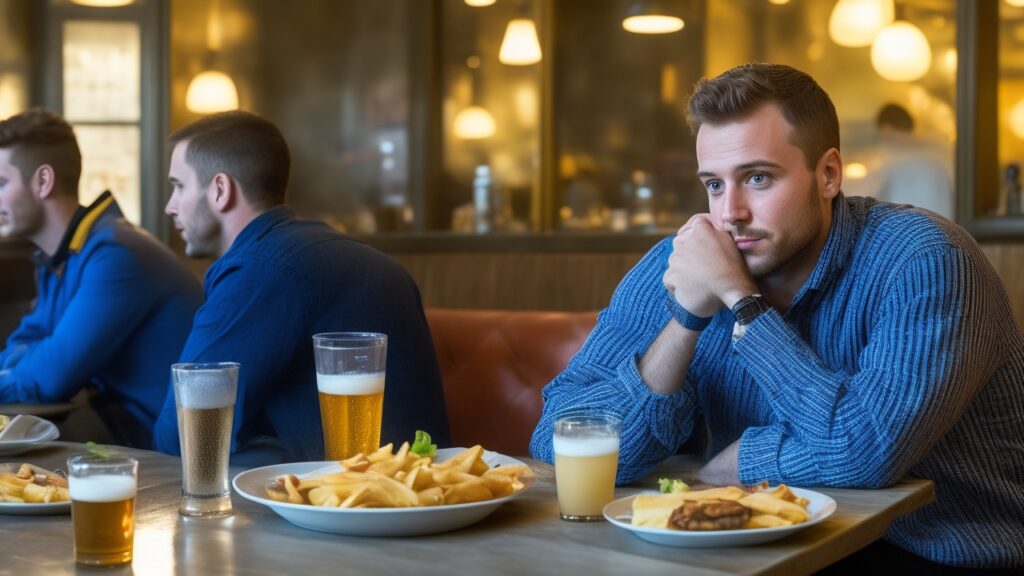
Plenty of men are tightening up their eating, turning up to football every week, and still wondering why the scales barely move – and for a lot of us, the answer is quietly sitting in our pint glass.
This article looks at how alcohol affects men’s weight loss, why those weekend drinks can undo a week of good intentions, and what you can realistically do about it – without needing to swear off the pub for life.
Why alcohol matters so much for men trying to lose weight
When you’re focusing on weight loss, it’s easy to think about food and exercise but forget about what you’re drinking. Alcohol brings in extra calories, can lower your willpower around food, and often comes with takeaways and snacks on the side.
The NHS explains that alcohol contains around 7 calories per gram – almost as many calories as fat, which has 9 calories per gram – and significantly more than carbohydrate or protein, which have 4 calories per gram.[2][5][11] That means alcohol can make a serious difference to your daily calorie intake, even if your meals are relatively healthy.
On top of that, the UK Chief Medical Officers’ guidelines recommend adults aim for at least 150 minutes of moderate activity or 75 minutes of vigorous activity a week, plus strength work on 2 days and reduced sitting time.[4][12][13][15] If you’re putting in that effort through football, walking or gym work, it makes sense to avoid undoing it with calories you barely notice.
How many calories are really in common drinks?
It’s surprisingly easy to drink the equivalent of a full extra meal without realising. According to NHS guidance, a standard 175ml glass of 12% wine can contain up to 158 calories and a pint of stronger lager up to 222 calories.[2] Other NHS and hospital resources in the UK show similar ranges, with a pint of lager typically around 170–220 calories and popular spirits and alcopops providing well over 100 calories per serving.[5][11][14]
To put that in context:
- A pint of beer can be similar in calories to a small sausage roll or a mince pie.[14]
- A single glass of wine can be close to a bag of crisps or a slice of pizza in calorie terms.[14]
- One unit of alcohol (around 8g) provides about 56 calories – roughly the same as a custard cream biscuit.[5][11]
Now think about a typical night: 4 pints of lager could easily mean 700–800 calories or more. That’s close to a whole extra meal on top of your usual intake.
The yearly impact: why “just a few drinks” adds up
The NHS points out that drinking 4 bottles of 12% wine a month can add up to around 32,400 calories over a year.[2] That’s more than two weeks’ worth of food calories for many men. Similarly, 5 pints of strong lager each week can mean about 57,720 extra calories in a year.[2]
If you roughly convert that to body weight, a commonly used estimate is that 3,500 calories equals about 1lb (around 0.45kg) of body fat. That’s only a rough guide, but it shows how the numbers stack up. Those 57,000+ calories from regular pints across a year could easily be the difference between slow, frustrating progress and steady weight loss.
For men playing in MAN v FAT Aintree, this is particularly important. You might be getting your weekly football in, weighing in, and doing your bit for the team – but if your alcohol intake is high, it can quietly cancel out the calorie deficit you’re working hard to create.
How alcohol affects hunger, choices and motivation
Alcohol doesn’t just add calories directly – it also influences what and how much you eat. Research highlighted by UK health organisations shows that drinking can lower inhibitions around food and is often linked with higher calorie intake later that evening, including extra snacks and more drinks.[10]
Once you’ve had a few, it’s harder to stick to your planned meals or say no to the takeaway on the way home. This “tipping point” can mean you eat thousands more calories than you intended across a night out, especially if you don’t adjust your intake the next day.[10]
Alcohol can also affect sleep quality, leaving you more tired and less motivated to exercise or cook properly the next day. Poor sleep can increase cravings for high-calorie, high-sugar foods and make it harder to resist temptation.
Balancing an active lifestyle with real-life drinking habits
The aim here isn’t to tell you to stop drinking altogether. For many men, alcohol is social, part of football culture and part of life. The key is understanding the impact and making choices that support your goals rather than constantly fighting against them.
The UK guidelines suggest keeping health risks low by not regularly drinking more than 14 units of alcohol per week, spread over at least 3 days.[2] If you are trying to lose weight, staying within or below this level, and choosing lower-calorie options, can make weight loss far more manageable.
Practical ways to cut alcohol calories without going teetotal
If you want to lose weight and still enjoy a drink, focus on simple, realistic changes rather than extreme rules you’ll abandon after a fortnight.
- Set a clear weekly limit: Decide in advance how many drinks you’ll have across the week, aiming to stay at or below 14 units. Spread them over several days rather than loading them all onto one big night, and write it down so you’re accountable.
- Choose lower-calorie drinks: Swap high-strength lager or cider for lower-strength versions, choose single spirits with diet mixers instead of sugary cocktails, and consider smaller glasses of wine rather than large serves. These changes can significantly reduce your total calorie intake from alcohol.[2][14]
- Avoid the “tipping point”: Plan to stop drinking before you reach the stage where willpower drops and food decisions go out the window. Arrange your night so you finish with a soft drink or water, or set a hard limit on pints before you arrive.
On top of that, it helps to separate drinking from eating. If you know a particular takeaway is your weakness after a few drinks, have a different plan ready: a pre-cooked meal at home, healthier snacks, or a rule that you eat before you go out so you’re not starving when the bar closes.
Using football and community to support better habits
One of the strengths of MAN v FAT Aintree is that you’re not doing this alone. The league combines football, weekly weigh-ins and team accountability. If alcohol is a sticking point for you, that environment can be a big help.
Here are some ways to use football and community to support better drinking habits:
- Share your goal with your team: Let your teammates know you’re trying to cut back on alcohol calories. It’s easier to stick to your limits when other people understand why you’re making different choices.
- Make match night a low-alcohol night: Plan ahead so your league night is focused on football, hydration and recovery rather than being the start of a big drinking session. That helps your performance on the pitch and your progress on the scales.
- Try alcohol-free alternatives for post-match socials: If your team enjoys a drink after the game, experiment with alcohol-free beers or soft drinks some weeks. Many alcohol-free options now taste similar to standard lager but with far fewer calories.
By connecting your drinking goals to something positive – your performance, your team’s success, your health – you shift the focus away from restriction and towards what you gain by making a change.
How to spot if alcohol is slowing your progress
Sometimes men feel stuck with weight loss and blame their training or diet, when alcohol is quietly playing a much bigger role than they realise. A simple check is to track your intake honestly for two or three weeks.
Write down:
- What you drink, including size and strength (pints, measures, ABV if you know it).
- When you drink (weeknights, weekends, match nights, events).
- What you eat around those drinking occasions (takeaways, snacks, extra meals).
Compare that to your activity levels. Are you close to the recommended 150 minutes of moderate activity or 75 minutes of vigorous activity a week?[4][12][13][15] If you’re putting the effort in and still not seeing change, your alcohol log may reveal why.
If you spot patterns – heavy drinking at weekends, extra calories from takeaways every time you drink, “rewarding” yourself with food because you’ve played football – these are the places to start making changes.
Building a sustainable balance for long-term weight loss
The goal isn’t perfection, it’s balance. Sustainable weight loss comes from consistently taking in fewer calories than you use, week after week, without making life miserable. For many men, reducing alcohol is one of the most effective and least painful ways to cut calories.
Think about what balance looks like for you:
- Maybe you keep one or two nights a month where you drink more, and cut back strongly on other weeks.
- Maybe you switch to lower-calorie options most of the time and save stronger drinks for special occasions.
- Maybe you keep alcohol for social events, not for routine nights at home.
Combine that with regular football, walking, or other activity that helps you hit the UK guidelines for weekly movement, and you’re in a strong position to see steady progress on the scales.[4][12][13][15]
A positive next step
If you recognise yourself in this article – eating well, playing football, but still stuck – then your next step doesn’t have to be dramatic. Start by tracking what you drink for a couple of weeks and choosing one simple change: one less pint, a lower-calorie alternative, or a rule that you stop before the takeaway cravings kick in.
As you build those changes into your routine, you’ll likely find that your weight loss feels more predictable, your football feels easier, and your energy improves. And if you’re not yet part of a supportive community, getting involved with something like MAN v FAT Aintree can give you the accountability, encouragement and team spirit that make sticking to those decisions much easier.
You don’t need perfection to make progress – just a few honest changes, backed up by steady effort on and off the pitch.